IPA SDG – Goal No 12 – Responsible consumption and production

Ensure sustainable consumption and production patterns.

We have

330

of 1000 actions

Since RSC Sustainability opened for submissions in 2022, the journal has required authors to submit a Sustainability Spotlight statement. This short summary, published alongside all articles, describes how the research contributes to sustainable progress and supports the UN Sustainable Development Goals. This helps reviewers assess the relevance of the article for a broad audience, while allowing readers to set the research in a broader context.

Relevant SDG’s

IPA SDG – Goal No 4 – Quality EducationIPA SDG – Goal No 12 – Responsible consumption and production

At Microbe 2025, a dedicated mini-symposium was held to discuss how microbiologists and microbes can further the SDGs. Expert panels held conversations about microbiology as a roadmap for progress, through the use of microbes to mitigate climate effects, generate renewable energy solutions, and advance the bioeconomy, and discussed the crucial role of education both as its own target and as a core part of achieving all of the goals.

Relevant SDG’s

IPA SDG – Goal No 4 – Quality EducationIPA SDG – Goal No 12 – Responsible consumption and production

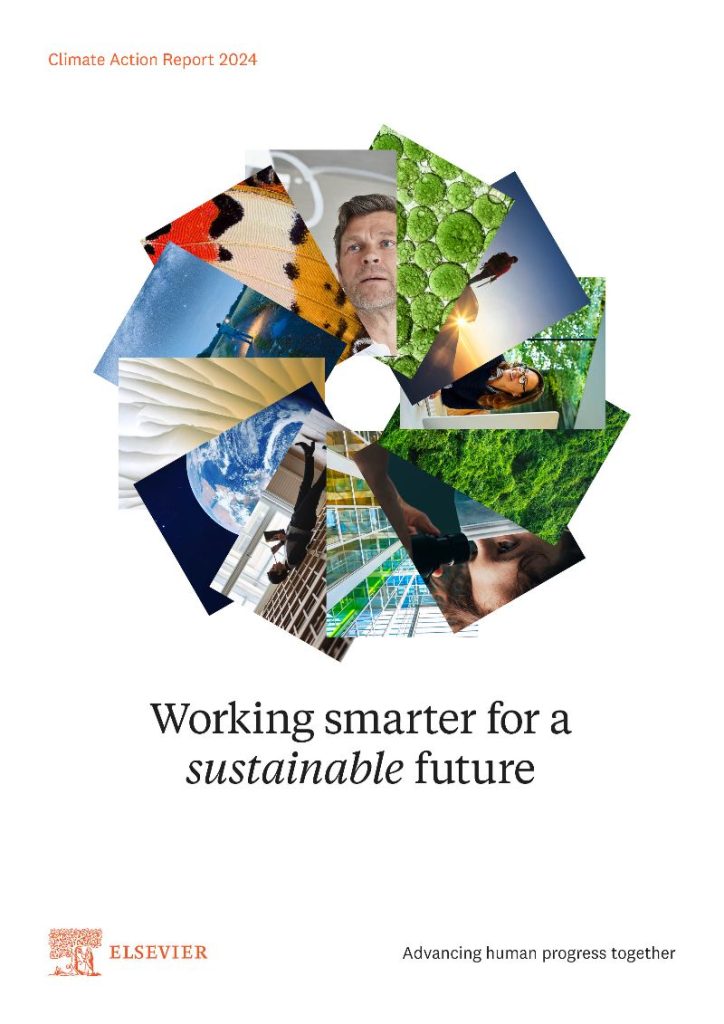
In 2024, Elsevier cut direct emissions by 83% (since 2018) and saw 86% of top suppliers disclose CO₂ data, covering 94% of eligible spend. New titles like Cell Reports Sustainability and biodiversity analytics reinforced its role in climate research, while conferences adopted carbon footprint tracking. Through the Elsevier Foundation, programs like the Chemistry for Climate Action Challenge advanced SDG 13, showcasing Elsevier’s leadership in climate action.

Relevant SDG’s

IPA SDG – Goal No 12 – Responsible consumption and productionIPA SDG – Goal No 13 – Climate action

Every digital article hosted, accessed, and cited online carries a measurable carbon cost. While the transition from print to digital has vastly improved global access to research, it has also introduced a new kind of environmental impact — one that often goes unseen. The STM Digital Carbon Calculator, built on DIMPACT methodology, enables publishers to measure the carbon emissions associated with their digital content and better understand their digital footprint.

Relevant SDG’s

IPA SDG – Goal No 12 – Responsible consumption and productionIPA SDG – Goal No 13 – Climate action

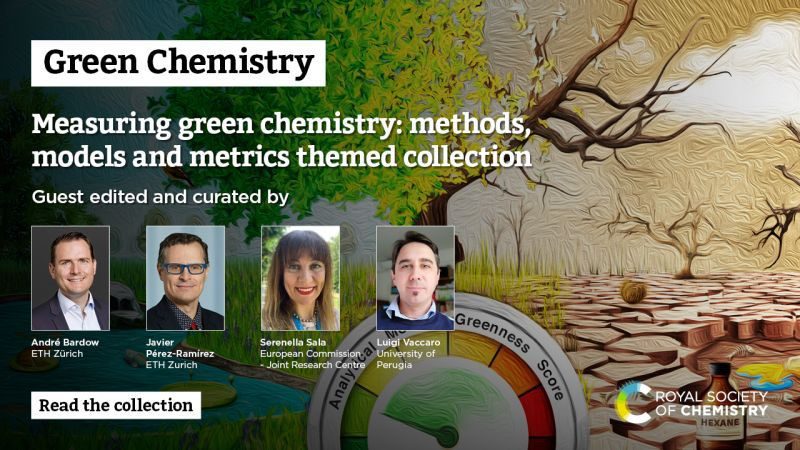
This cross-journal collection gathers scientific publications that focus on measuring advancements in sustainability. The work showcased provides insight into the benefits and trade-offs of different methods, models, and metrics, supporting readers and authors to measure, compare, and describe the advantages and disadvantages of introducing green chemistry principles and approaches in their work. The collection is intended as a guide and accessible resource for the whole chemistry community.

Relevant SDG’s

IPA SDG – Goal No 4 – Quality EducationIPA SDG – Goal No 12 – Responsible consumption and production

Now published alongside all articles in the journal Green Chemistry, the Green Foundation box contains three questions through which authors can concisely summarise and quantify their work in terms of the green chemistry principles that have been applied. This allows the editor and reviewers to ascertain the green advance that the work presents, while facilitating readers to easily determine the wider sustainability/societal impact.

Relevant SDG’s

IPA SDG – Goal No 4 – Quality EducationIPA SDG – Goal No 12 – Responsible consumption and production

The new program has three parts. The first will be a carbon footprint calendar to be created in the form of a digital platform, allowing publishers to measure the carbon emissions of each work published. A life-cycle analysis is next, monitoring “the individual trajectory of two printed works and their digital environment, in an attempt to support decision-making and modes by which environmental performance can be improved. Finally training will be the third and final element.

Relevant SDG’s

IPA SDG – Goal No 12 – Responsible consumption and productionIPA SDG – Goal No 13 – Climate action

As a diamond open-access journal, “English Studies at NBU” is committed to making knowledge accessible to everyone while addressing global challenges. We take sustainability seriously. Our operations are entirely virtual, with remote offices and online meetings, and minimal needs to travel, which reduces our environmental impact. We reach a broad enough audience through our online publications and from 2025, we plan to switch to a “Print on Demand” model, phasing out traditional print runs.

Relevant SDG’s

IPA SDG – Goal No 12 – Responsible consumption and productionIPA SDG – Goal No 13 – Climate action

As part of the Princeton University Press’ commitment to environmental sustainability, the Press launched its first issue of the PULP sustainability newsletter, aimed at educating and informing its staff of environmental issues within the publishing industry, as well as the sustainability initiatives being undertaken by PUP, under the guidance of its Sustainability Working Group. The newsletter is an educational tool to bring more awareness to sustainability to the Press’ employees.

Relevant SDG’s

IPA SDG – Goal No 12 – Responsible consumption and productionIPA SDG – Goal No 13 – Climate action

Beginning in 2022, Princeton University Press (PUP) has committed to using only book papers rated three stars or higher by the Book Chain Project, as determined by a tool called Forest Risk Assessment, which assigns a grade to each paper brand and type. PUP has also increased its use of paper certified by the Forest Stewardship Council (FSC) and continues to prioritize the use of FSC-certified paper whenever possible.

Relevant SDG’s

IPA SDG – Goal No 12 – Responsible consumption and productionIPA SDG – Goal No 15 – Life on land

UQP actively acquires and publishes titles that explore current social and environmental issues to help educate readers and spark important conversations, including Royce Kurmelovs’s SLICK, which provides an on-the-ground examination of how the fossil fuel industry captured Australia, and outlines what’s at stake for the survival of the planet, and King and Sparrow’s OUT OF THE BOX, which brings together expert advice, interviews and up-to-date resources to help ND children thrive.

Relevant SDG’s

IPA SDG – Goal No 10 – Reduced inequalitiesIPA SDG – Goal No 12 – Responsible consumption and production

In 2020, UQP launched its own sustainability team to develop sustainable business practices from an environmental and social perspective.

Relevant SDG’s

IPA SDG – Goal No 12 – Responsible consumption and productionIPA SDG – Goal No 13 – Climate action

UQP is committed to responsible waste management. At our head office, we collect multiple waste streams to be recycled including soft plastics, e-waste, fluorescent tubes, coffee pods and organics. Via UQ’s internal recycling program, UQP’s soft plastics are downcycled into products like decking, wheelie bins, park benches, shipping pallets, bottles and even playgrounds.

Relevant SDG’s

IPA SDG – Goal No 12 – Responsible consumption and production

Orders from UQP’s online store are packaged using reused boxes, recyclable mailers made with 100% recycled newspaper, recycled packing paper and compostable packing peanuts. UQP have also done away with printed invoices in favour of digital receipts.

Relevant SDG’s

IPA SDG – Goal No 12 – Responsible consumption and production

Recycle EVERYTHING Month proved to be a triumph!
The Wiley Australia Community & Social Responsibility Committee rallied our Brisbane, Melbourne, and remote teams for a month-long endeavor dedicated to recycling and donating goods.
The result? Over 275lbs of items were collected across all our offices.

Relevant SDG’s

IPA SDG – Goal No 12 – Responsible consumption and productionIPA SDG – Goal No 13 – Climate action

HarperCollins and News Corp have partnered to offer employees enrollment in the Carbonauts’ Sustainability Bootcamp, an engaging six-week program where you’ll discover the fundamentals of sustainable living and how to apply them in your own life.

Relevant SDG’s

IPA SDG – Goal No 11 – Sustainable Cities and CommunitiesIPA SDG – Goal No 12 – Responsible consumption and production

The new HarperCollins facility in Robroyston, Glasgow, including distribution center and offices, is due to open in 2025 and is being built with sustainability in mind. The site is being built to BREEAM ‘very good’ standard – this means it will be operating to a high standard on areas including energy and water usage, pollution, waste and ecology. Features will include solar panels, rain water recycled for bathrooms, and landscaping that will promote the local ecosystem.

Relevant SDG’s

IPA SDG – Goal No 9 – Industry, Innovation and InfrastructureIPA SDG – Goal No 12 – Responsible consumption and production

Saving nearly 200 metric tons of carbon emissions in fiscal 2023 through HarperCollins UK’s transporting of books from Europe to the U.K. by rail instead of trucks.

Relevant SDG’s

IPA SDG – Goal No 12 – Responsible consumption and productionIPA SDG – Goal No 13 – Climate action