Make your SDG related action count!
Turning the Page supports the UN campaign of 1 Million Actions for Our Common Future.

we have

345

of 1000 actions

Beyond 2030 is based on high-level interviews with the United Nations 10-Member Group on STI for SDGs and reviews the framework’s achievements to date and provides critical guidance on how the SDGs can continue to foster global cooperation and support SDG-aligned research. It also presents a bold vision for how the SDG framework should evolve post-2030.

Relevant SDG’s

IPA SDG – Goal No 4 – Quality EducationIPA SDG – Goal No 17 – Partnerships for the Goals

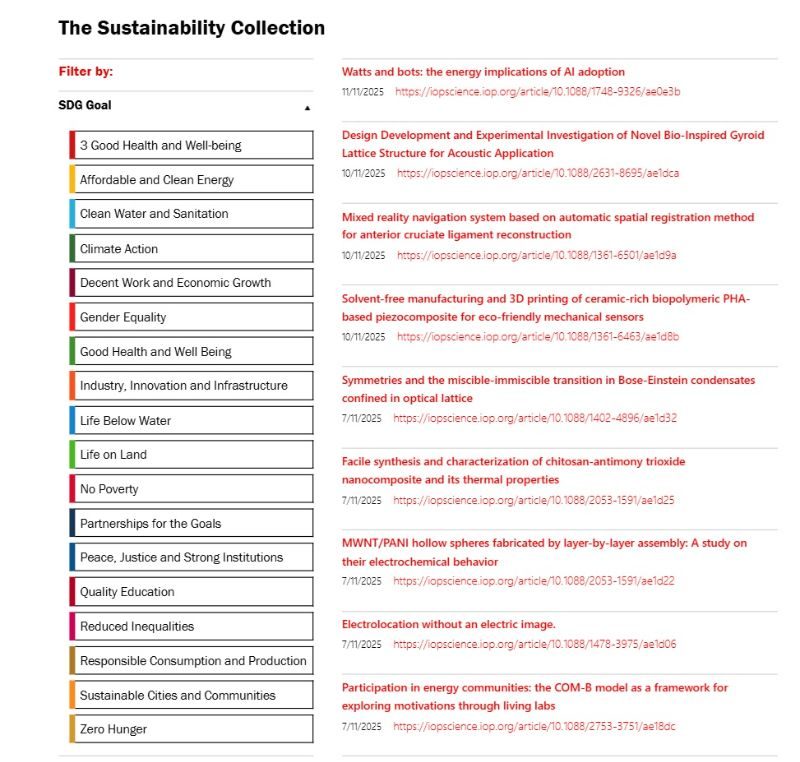
IOP Publishing’s Sustainability Collection is a dedicated hub for research aligned with the UN Sustainable Development Goals (SDGs). It brings together research across disciplines—from climate science and clean energy to health and education. A user-friendly search tool lets you filter by SDG or publication year, helping to find high-quality research that supports global efforts to tackle environmental and societal challenges.

Relevant SDG’s

IPA SDG – Goal No 17 – Partnerships for the Goals

The 18th EASE General Assembly and Conference “Editing in the age of misinformation” hybrid (in-person and online) conference was in Oslo on 14–16 May 2025 and featured dynamic content comprising sessions, pre-conference workshops, and speakers from around the world. This a format for future conferences, since it helped reduce travel-related emissions. Further, conference related activities involved planting 194 trees via the EASE Global Forest initiative instead of distributing delegate gifts,

Relevant SDG’s

IPA SDG – Goal No 12 – Responsible consumption and productionIPA SDG – Goal No 13 – Climate action

A new report from Springer Nature, in partnership with Overton, offers the most comprehensive picture yet of how academic research is influencing real-world policy tied to the SDGs. Published during COP30, the analysis is the first of its kind, drawing on more than 12 million policy documents. It finds that SDG policy documents seem to cite more research than non-SDG policy, signaling a connection between science and action on global challenges such as health, climate, and social development.

Relevant SDG’s

IPA SDG – Goal No 13 – Climate actionIPA SDG – Goal No 17 – Partnerships for the Goals

SDGenie (beta) is a new, prototype tool that explores how text, such as research abstracts, can be matched to specific targets set out in the Sustainable Development Goals (SDGs). SDGenie (beta) is free to use and offers researchers a new way to identify detailed targets – rather than goals alone – and, therefore, to make their work more relevant to the SDGs. There are 169 targets, which define actionable priorities. Together with indicators, they help to measure progress.

Relevant SDG’s

Zero hungerIPA SDG – Goal No 15 – Life on land

Applied and Environmental Microbiology (AEM) calls for papers in a Special Series on Agricultural Biotechnology, including cutting-edge research on microbial innovations contributing to fundamental, translational progress toward sustainability. AEM invites researchers worldwide to submit work on diverse agricultural scales, systems, and practices, from temperate and tropical cropping systems to arid and high-altitude environments and from smallholder farms to industrial-scale operations.

Relevant SDG’s

Zero hungerIPA SDG – Goal No 13 – Climate action

Since RSC Sustainability opened for submissions in 2022, the journal has required authors to submit a Sustainability Spotlight statement. This short summary, published alongside all articles, describes how the research contributes to sustainable progress and supports the UN Sustainable Development Goals. This helps reviewers assess the relevance of the article for a broad audience, while allowing readers to set the research in a broader context.

Relevant SDG’s

IPA SDG – Goal No 4 – Quality EducationIPA SDG – Goal No 12 – Responsible consumption and production

At Microbe 2025, a dedicated mini-symposium was held to discuss how microbiologists and microbes can further the SDGs. Expert panels held conversations about microbiology as a roadmap for progress, through the use of microbes to mitigate climate effects, generate renewable energy solutions, and advance the bioeconomy, and discussed the crucial role of education both as its own target and as a core part of achieving all of the goals.

Relevant SDG’s

IPA SDG – Goal No 4 – Quality EducationIPA SDG – Goal No 12 – Responsible consumption and production

To foster both quality education in college STEM classrooms with teaching assistants (TAs) as well as the career development and skills of TAs themselves, JMBE held a special call for papers on TA professional development, organized by senior editor Jeffrey Olimpo. The resulting article collection covers a variety of topics like TA program development, assessments, and mentoring, relevant in numerous educational communities and contexts globally, to ensure graduates have the knowledge they need.

Relevant SDG’s

IPA SDG – Goal No 4 – Quality Education

In a Meeting Highlight, Richard Beckett et al. discuss top-ranked priority research questions resulting from the Probiotic Cities Working Group’s global interdisciplinary workshop, as well as their broader implications for microbiome science, urban health, and sustainable development. By focusing on these priorities, researchers, policymakers, and practitioners can foster a transformative agenda to integrate microbiomes into urban design, advancing resilient and equitable cities for the future.

Relevant SDG’s

IPA SDG – Goal No 11 – Sustainable Cities and Communities

mSystems provided waiver codes to promising early-career researchers who presented at the Center for Microbiome Innovation International Microbiome Meeting, EcoFAB 2025, and Microbial Dark Matter Symposium, allowing them to publish in any ASM journal, regardless of their ability to pay publication charges.

Relevant SDG’s

IPA SDG – Goal No 10 – Reduced inequalities

American Society for Microbiology, with Kriyadocs, has enhanced its published content to serve a diverse global audience by incorporating alternate text (alt-text) for figures and implementing new table and figure standards for an accessible, inclusive reader experience.

Relevant SDG’s

IPA SDG – Goal No 10 – Reduced inequalities